
Nn't po fdà manck d'llà ckammicia ck port ncoglie! (You cannot trust not even the shirt that you wear!)
Ciociaria (Italy) Peasant Proverb, Time Immemorial
You can take the person out of the Stone Age, not the Stone Age out of the person.
Nigel Nicholson, Harvard Business Review, Jul-Aug, 1998
Takeaways
At the bottom of it all, life is interaction with other humans. There are no good or bad humans out there. There are just humans marching to the beat of primal survival instincts honed by mother nature over millions of years. These instincts are for preservation of self. So, all humans are predisposed by nature to always seek ways to use others for self advantage. Each one of us, to avoid getting hurt (physically, emotionally, or financially) must take precautions when dealing with other humans regardless of their walk of life. We must always remember the Need Imperative and the Shoemaker Principle! And must refuse to be enslaved by think-boxes when making decisions. We must dare to think for ourselves outside of the boxes !
Human Drives
By the time I have got to my age, I have had to deal with many different people under many different situations. Pretty well in all instances, some human traits have always prevailed. Although on the surface people are amazingly agreable, kind, generous, and unselfish when their "paychecks" are not threatened, they are also just as amazingly not agreable, not kind, not generous, and selfish when their "paychecks" are threatened. And this happens even if the subject matter to be agreed to is fundamentally fair, ethical, lawful, and scientifically correct.
As an example, it seems impossible to have anybody accept the usefulness of new knowledge, even if absolutely correct, if this acceptance threatens their "paychecks". And this disagreement is defended at all costs even if it means continuing procedures or production and distribution of products that are harming people.
One example is the continuing sale of Tobacco products vigorously promoted by the Tobacco industries and sheepishly acquieshed by our regulatory bodies. And this even after Tobacco has been singled out as one of the worst risk factor for several diseases including lung cancer! Why? Because the addictive power of Tobacco fuels a multi-billion dollar business with many people getting their payhecks from it. Might there be a more sinister reason? Might it be because Tobacco makes people sick and there are several multibillion dollar businesses that make money only if people are sick, and these businesses have strong vested interests in having the sale of tobacco products continue?
Another example is the rejection of the miraculous health benefits of vitamin C by "the powers that be" in the delivery of health care. And this rejection continues eventhough the benefits of vitamin C have been proven by several researchers, have been documented in several articles and books, and have been attested to by thousands of people that have used it, including myself (1,2,3,28,29,30,31). Vitamin C has been shown to be curative even in in the treatment of cancer (26,27,28), in the treatment of heart disease(29,30), and in the treatments of several other ailments (31, Body Changes) In spite of all this evidence in favour of using vitamin C, "the powers that be" in the delivery of health care refuse to consider use of vitamin C to benefit patients. Why? Might it be because vitamin C threatens several multibillion dollar businesses that make money only if people are sick?
Think-boxes
Powerful entities, including our government institutions, have become very adept at getting people to think and behave in ways that furthers their own financial or political objectives. These entities invest heavily to create "think-boxes" containing a number of unquestionable truths such that any thinking outside of these boxes is held to ridicule or worse. These think-boxes exploit basic human instincts to herd people into them. Three of these think boxes are briefly discussed below.
Cosmetics Think-Box
This think-box herds people into it by exploiting their survival instincts related to vanity. The unquestionable truths in this box are designed to "brain wash" people to believe in behaviour that maximizes income for the Cosmetics industries.
One of the unquestionable truth in the Cosmetics think-box is that "Cosmetics are essential to make women beautiful". Unfortunately for those that believe in it, this "truth" is very wrong because all cosmetics contain toxic chemicals that are absorbed into the body to create a fertile environment for all kind of diseases including cancer. These chemicals, as well as the procedures involved, are also well known to physically damage skin, eyelashes, hair, and nails. Also, it is well known that women become addicted to cosmetics to the point that they are "terrified" to show their faces without makeup. So, clearly, over time cosmetics make women more and more sick.
The unquestionable truths in the cosmetics think-box improves the profits of the cosmetic industry, but are bad for women. As radiant beauty can only flow from radiant good health, over time use of cosmetics makes women sick and, as a result, not beautiful at all. Sick women cannot be made beautiful with the "cosmetics" that you put on them! Nonetheless, most women remain enslaved by this think-box.
Wind Power Industry Think-Box
This think-box herds people into it by exploiting their survival instinct that nature is good and needs to be protected. The unquestionable truths in this box are designed to "brain wash" people to believe into the "holiness" of wind power, while wind power is in-fact bad for the environment and is diverting attention from more environmentally friendly and practical technologies. Again, the purpose of these truths is to maximize the income and the achievement of political objectives of those with vested interests in wind power technology, rather than the protection of the environment.
One of the unquestionable truth in this box is that "Electrical wind power is best to prevent Climate Change". This could not be furthest from the truth!
Climate is largely determined by wind current patterns. Wind turbines "mine" energy out of wind currents and thus weaken these currents. To maximize return on investments, wind turbines are placed on the path of the strongest and prevailing wind currents. Accordingly, wind turbines weaken the strongest and prevailing winds by taking energy out of them. As the wind current patterns that impact climate result from many competing wind currents, the weakening of the strongest and prevailing winds will result in different winds to become strongest and prevailing and this results in changed wind current patterns. Accordingly, the wind turbines cause wind current pattern changes and thus causes climate changes. So, not only wind power does not help climate change, it is making it worse! Nonetheless people remain "enslaved" by this think boxes because of the vigorous promotion of the truths in this think-box by vested interest groups. The fact that today wind power is generated in one location and consumed several miles away from it, introduces additional factors that also contribute to current pattern changes. Discussion of these additional factors would take too much space for consideration here.
Organized Medicine Think-Box
A last example entertained here, is the Big Pharma think-box. People are herded into this box by exploiting people natural survival instinct that makes them fear death. The unquestionable truths in this box are designed to convince people of the "holiness" of the health industries. And people are "brain washed" to believe that if they wish to stay alive, they better follow without questions the advice of their doctors and take the prescribed medication. These truths are definitely being very successful in fuelling a multy-trillion health industry, but clearly they are not "fuelling" a healthy population. In fact nowadays physiological diseases have reached epidemic proportions.
One of the unquestionable truth in this think-box is that "Doctors know what is best for you and can be trusted blindly". Without question, doctors are very knowledgeable and respectable humans, but they are humans just like us and they are subject to the same limitations and survival drives that we all have. In particular, doctors also need to make a living and, therefore, they also are subject to the NEED Imperative and Shoemaker Principle tenets. These tenets would suggest that, in fact, doctors maybe biased to keep us alive, but sickly, rather than alive and healthy.
One example of this bias is the doctors insistence in having us take cholesterol (LDL) lowering drugs. These drugs have a long list of serious side effects that make people sick. And I know from personal experience because I did take these drugs several years ago. And this insistence is still with us today, even after years that science has established (29,32) that the true risk factor for heart disease is the levels of Lipoprotein(a) (Lp(a)) and not the levels of LDL and HDL lipoproteins.
We also know, since the 1991 paper by Linus Pauling and Rath (29), that high levels of Lp(a) are signalling a vitamin C deficiency, and that Lp(a) levels are reduced by vitamin C supplementation. In subsequent work, Linus Pauling provided regimens to cure and prevent heart disease. To prevent: 3000 to 10,000 mg of vitamin C daily; 2,000 to 4000 mg of Lysine daily. To cure: 6000 to 18,000 mg of vitamin C daily; 5,000 to 6000 mg of Lysine daily. This inexpensive, side-effects free, and successful remedy used by thousands (30), has been totally ignored by Big Pharma which has instead initiated expensive research to develop drugs to lower Lp(a) levels, and on how to use lipoprotein apheresis to lower Lp(a) levels (32). Could this be because treatment of heart disease makes multi-billion dollars of profits for the heart-health industries and a heart disease cure would make all these profits evaporate?
Accordingly, doctors should be testing for Lp(a) and not LDL/HDL to establish your risk of heart disease and prescribe you vitamin C if your Lp(a) is too high. And, definitely, should not keep pushing us to take dangerous LDL/HDL lowering drugs because levels of these lipoproteins do not represent risk factors for heart disease! So, why the push for unnecessary and dangerous LDL/HDL lowering drugs?
So, if you are unfortunate enough to need to see a doctor, listen to his/her advise but do not take it as a "command". Before submitting to any tests or taking any drugs that your doctors advises, do your own research and make your own decision. My own experience is that it is best to stay away from prescription and over the counter drugs except in the short term to survive emergencies. It is your health at stake! Remember that drugs always cause several side effects that often are worse than the condition that they are supposed to treat. Also remember that drugs today treat the symptoms and not the disease (36). Ask for what is causing the symptoms and what the doctor is doing about it. And if he/she does not know the root cause for your ailments, he/she cannot know how to cure them! My own experience is that your best bet is to start eating good food, supplement with vitamins and minerals, and adopt a healthy lifestyle. Sometime, surgery can be very useful, but the subsequent chemotherapy and radiation should be avoided absolutely because these procedures cannot target cancer cells only.
Am I saying that doctors cannot be trusted because they are bad? Absolutely not!!! As I said before, doctors are very knowledgeable and very respectable people just like most of us. What I am saying is to never forget that doctors are human just like us. And, as humans, they also share in our survival drives including tending to be biased in making decisions that improve their "paycheck" ... just as any other human! So, use with them the same precautions that you use with any other human.
Think-Boxes Discussion Takeaways
What is the essence of my message from the above discussion? It is that when making decision that affects us and our loved ones, we must dare to think for ourselves and outside of the boxes! We are on our own! And we must never forget the Cioceria peasant wisdom "You cannot trust not even the shirt that you wear!" which incapsulates the wisdom from thousands of years of experience dealing with humans.
And I cannot resist mentioning another takeaway. If parents had remembered the above Cioceria peasant wisdom, they would not have had their kids sexually abused by their priests!
Making Sense Of Human Behaviour
I have spent a fair amount of time rationalizing why humans are capable of such ungenerous, unfair, unethical, selfish, and even criminal behaviour even though at the same time they seem to be equally capable of the most generous, fair, ethical, unselfish, and lawful behaviour. I have concluded that humans are driven foremost by their innate insticts for survival beyond reason, and when this survival is threathened, these instincts drive them to behave badly.
My attempt at rationalizing human behaviour which by any meter is clearly unfair, unethical, and even criminal, has led me to the formulation of the two following pragmatic tenets about humans. These tenets are articulated below:
The Need Imperative
We all come into this world equipped with instinctive survival drives that have evolved over billions of years. The objective of these drives is to secure survival of ourselves and of our families through which we ensure survival of our genes. These survival drives translate into what we refer to as needs (Maslow 16). Driven by these needs, we are continually engaged in activities to either satisfy our needs or activities to secure the means by which our needs and the needs of those close to us can continually be satisfied. In today’s world, this means that we all need to make enough money. And, driven by our hoarding instinct, we continually strive to make more and more money just to be ready for a “rainy day”. Furthermore, as we are all somewhat different, while some of us are content with being comfortable enough, some others have the need for great power and control over others. But at the bottom of it all, whether we need just enough or whether we need a lot, we all march to the beat of a common imperative: the “Need to Make a Living Imperative" or “Need Imperative” for short.
Also, we all have innate senses of what is fair, ethical, moral, or criminal, and these senses are strengthened by the teachings we receive growing up. However, the Need Imperative trumps all these senses because survival is of foremost concern in our minds. It is evident from everywhere that we look that when it comes to keeping “our pay checks coming”, some of us are inclined to cut corners or worse. In my life, anyone that I have known, read about, or heard about, has been continually occupied with various activities all driven by the Need Imperative. Over time, laws have been put in place to discourage activities that are unfair, unethical, immoral, or criminal. As a result of these laws, some of us would pass the fair, ethical, moral, or criminal test, but many still would not. Institutions, as extensions of ourselves, are not immune to the Need Imperative. And in fact, often it is institutions that engage in the most heinous activities driven by this imperative. This is likely due to the distance that the structure of an institution places between the personal responsibilities of the people that run it and the responsibilities of the institution.
The Need Imperative can be articulated as follows:
Humans (as individuals, institutions, or businesses) are driven by stone-age selfish survival instincts to engage continually in activities to satisfy their needs or to secure the means by which their needs can be satisfied, without regard to whether these activities are fair, ethical, moral, or lawful.
For individuals, institutions, or businesses, the above imperative means that other individuals or institutions cannot be trusted blindly. Does this mean that people are all bad? Of course not! The people are not bad, they are just being human. Not unlike, say, a Tiger. If I go into the jungle and a Tiger eats me, is the Tiger bad? Of course not! She is just being a Tiger, and I have been foolish not to take precautions.
So, always remember to take precautions when dealing with any other human!
The Shoemaker Principle
I grew up in southern Italy in a small poor peasant community during the period marked by the start of the Second World War. The area that I grew up in was populated by a number of similar poor peasant communities all located within an area of about 150 Km in diameter.
The now famous southern Italy Highway 6, which the Allied Armies had to use to move north from their landing sites in southern Italy, sliced through the middle of the area where we lived. And Monte Cassino, the town where a three months battle raged at the beginning of 1943, was within our area and only about 40 Km from where we lived. Although I was only three years old at the time that this battle was raging, I still remember that the nights were continuosly alight from the explosions and the artillery fires. And I still remember the several occasions when my father and I had to scramble into the closest ditch, with water or not, to escape the bullets being fired from overhead planes. And while lying donwn in the ditches face down, I still can remember the shock waves from the explosions hitting my back as if I was being hit by a large hammer. A recurring nightmare that I kept having for about 30 to 40 years afterward, was that of a plane high in the sky pursued by a tracing projectile that eventually caught up with the plane and made it crash to the ground in flames.
The above is to highlight that my growing up days were very difficult. These were the days when we would be hungry all the time and the days when cats and rats could nowhere to be found because people had resorted to eating them.
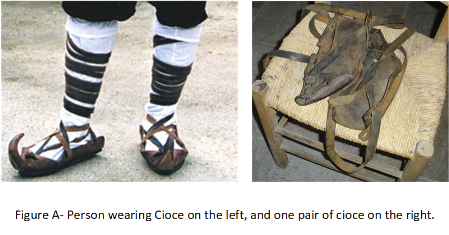
In those days, if one had a pair of shoes, he or she would save them for winter or special occasions. And to save the shoes in the winter, people would resort to wear "cioce" (singular: Ciocia). These consisted of two rectangular piece of leather whith holes along both of the longer sides for strings that were used to strap the leather pieces on the feet, after wrapping the feet in rags. The pieces of leather where twisted around into a point at the front. Cioce and a person wearing "cioce" is shown in Figure-A below. Because of this use of cioce, the area where I grew up was called, and is still called, "Ciociaria" or "Cioceria".
For the few lucky ones that had shoes, the shoes would come off in early April and stay off until the middle of December. During this period, we would walk barefooted all the time! And when wear and tear cracked the top leather or made wholes in the bottom soles, one would bring the shoes to a shoemaker to get the shoes repaired, because it was too expensive to buy new ones.
My father had a pair of shoes that he had had for years, and eventually the top leather of both shoes developed cracks. So he brought the shoes to our area shoemaker to have them repaired. When he went to pick up the repaired shoes he took me along. The shoemaker handed him the shoes beautifully shined and with nicely sewn leather patches that covered the cracks. My father paid and we went back home.
After an hour or so that we had returned, my father called "Dinu! come, I want to show you something!". I run to my father and found him holding one of his beautifully shined black shoes. He turned it on one side and showed me a razor thin cut, about two inches long, along the bottom of the top leather just above the inside midsole. The cut had been smeared over with the black polish and was hardly visible. "Do you see?" my father said, "The shoemaker has made sure that he will have more work from me in a couple of months from now because, with rain, the cut will cause the leather to crack much faster."
I was only about five years old at the time, but the image of the cut on the shoe has remained seared in my mind. And throughout my life I have experienced, as I am sure many others have experienced, similar behaviour from individuals or organizations that provide services. Our society today is rife with this practice, such as mechanics that break more than fix, food and drinks providers that add addictive substances to their drinks and food to "hook" customers so that they keep going back, prescription drugs that fix one health issue while causing many other health issues (side effects), dentists that drill healthy teeth, and the list goes on!
My experiences with service providers resorting to less than ethical or lawful trickery, including brain washing, to insure their continued and growing business, has led me to enunciate the following principle. I have named it the "Shoemaker Principle" in honour of our crooked childwood shoemaker who damaged my father's shoes to ensure return business. The Shoemaker Principle states the following:
"Humans that provide services (as individuals, institutions, or businesses) will do anything necessary to ensure that the customers of their services will remain continually in need of their services, without consideration of weather what they do is fair, ethical, moral, or lawful."
What are the takeaways from the above "Need Imperative" and "Shoemaker Principle"? It is a jungle out there! A jungle full of "tigers" lying in ambush to eat you up! So the message to each one of us is to trust nobody, regardless of who they are or they represent, and to take precautions in all of our dealings with other people. Always verify before trusting!
Do we need to take precautions because people are intrinsically bad? Absolutely not! It is because people are humans and they are driven by Mother Nature selfish survival instincts which, we have to admit, have worked extremely well judging from the number of people now inhabiting our planet.
Needless to say, all of us are humans, and we all have the same survival instinct and we all tend to similar behaviours. However, we all are born with innate senses of what is fair, ethical, or criminal and these senses are strengthened by the teachings that we receive growing up. The intensity of these senses varies in each individuals and, as a result, some humans end up living lives all mainly decent, while some others end up living lives all mainly criminal. We thank God that the majority of humans are mainly decent human beings!
But we need to always to remember that the Need Imperative and the Shoemaker Principle will always hold and shape the behaviour of individuals, institutions and businesses, and we must always take precautions in our dealings with them.